
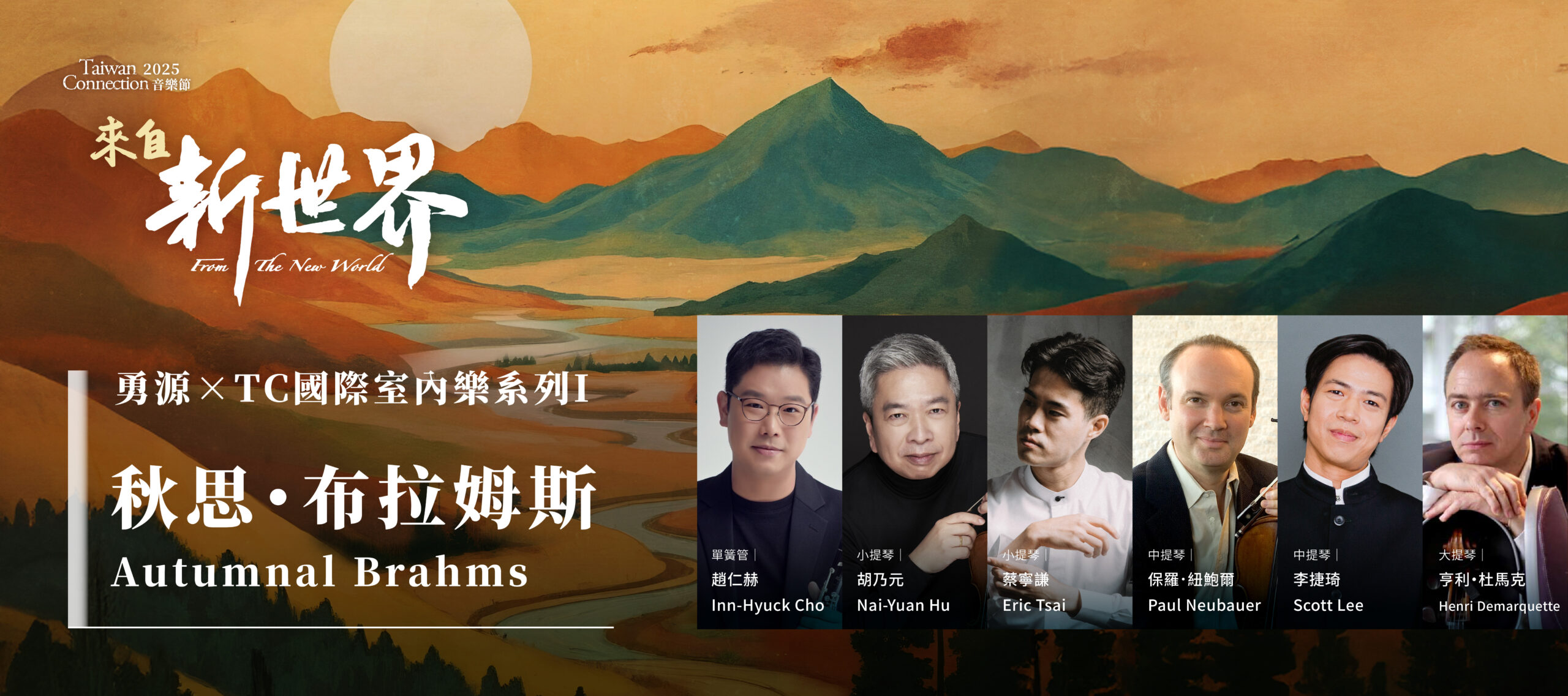
Autumnal Brahms ‒ Brahms at Life’s Twilight and the Empire’s Dusk
Browsing through the past years of the Taiwan Connection Festival programs, one notices a strong focus on 19th-century composers, especially Beethoven, Brahms, and Schubert. Among them, Brahms seems to lie at the heart of the chamber music repertoire. TC has programmed his String Sextets No. 1 and No. 2, the Piano Quintet No. 1, and the Horn Trio. Last year’s festival didn’t feature any Brahms, but this year he stands alone in a spotlight: “Autumnal Brahms” presents the Clarinet Quintet in B Minor and the String Quintet in G Major.
Brahms’s Concerto for Violin and Cello in A Minor, written in 1887, marked the beginning of the final decade of his life. The Clarinet Quintet and the G Major String Quintet came even later, in 1890 and 1891 respectively. The title Autumnal Brahms is indeed fitting.
In an era when the climate was still relatively stable, autumn signaled the retreat of summer’s heat, the shortening of daylight, and the approach of damp chill carried inland by the northeast monsoon. This kind of autumn—filled with melancholy and stillness—resonates with the subdued tone of the Clarinet Quintet. But sometimes, summer would lash back with sudden bursts of blazing sun and oppressive heat. The G Major String Quintet seems to capture that unexpected return of summer—a touch of “Indian summer.”
In Roman mythology, the god Janus has two faces, symbolizing duality and transition. The name of January comes from him, marking both the end of winter and the beginning of spring. The changing seasons always carry such dualities. Even autumn contains aspects of both summer and winter—it can be fervent and passionate, or bleak and withering.
These two works might be seen as the two faces of autumn, composed during the autumn of Brahms’s life. Old age was approaching; friends and rivals passed away one by one; each day of life grew shorter. And yet, the embers of youthful passion still glowed in his chest. His compositional technique had reached full maturity, and his expressive abilities flowed freely. In the G Major String Quintet—scored for two violins, two violas, and a cello—the energy of the opening movement shows no sign of a man in his sixties. The cello melody is robust and earthy, like an old man in a tavern, his face covered in a white beard, but with a booming voice and a hearty appetite rivaling any youth.
The rondo of the fourth movement carries even stronger folk elements. The world evoked here connects closely to that of Dvořák. The coda, in particular, is like shoveling more coal into the furnace of a steam locomotive—it’s no longer just an old man’s private revelry, but a tavern-wide eruption of joy. No reason is needed to celebrate. The piece sounds spontaneous and exuberant, like improvisation, yet every part is tightly woven, precisely dovetailed, and rhythmically rich. It is far from the simplicity of traditional folk music—Brahms’ craftsmanship is clearly that of a seasoned master.
This is one facet of Brahms’s autumn reflections. At the same time, it could be said to mirror the autumn of the Austro-Hungarian Empire itself. Emperor Franz Joseph I, just three years older than Brahms, ascended the throne in 1848 following the revolutions, and ruled until his death in 1916—a 68-year reign, even longer than Queen Victoria’s 63 years. Yet upon his death, the Austro-Hungarian Empire swiftly collapsed.
At the beginning of Franz Joseph I’s reign, he pursued ambitious modernization projects—tearing down the old city walls and replacing them with the grand Ringstrasse boulevard. Along this avenue, major public buildings such as the Vienna State Opera, the University of Vienna, and the Parliament Building were construct- ed. Vienna’s urban renewal and development in the latter half of the 19th century must have left a deep impression on Brahms.
Yet behind the prosperity, the pressures of the empire and growing social divisions became increasingly pronounced. In music, Hungarian and Bohemian elements could be seamlessly woven in, but in reality, tensions among the empire’s diverse linguistic and cultural groups were intensifying. Unfortunately, the rise of Prussia—and its unification into the German Empire in 1870— undermined Austria-Hungary’s international standing and further weakened its ability to maintain internal control.
Whether willingly or not, Franz Joseph I could only continue the policies of Chancellor Metternich, responding to the situation with a mix of repression and appeasement. To make matters worse, Franz Joseph’s only son with Empress Elisabeth, Crown Prince Rudolf, died by suicide alongside his lover at the imperial hunting lodge on the southern outskirts of Vienna. This tragic event occurred in 1889 and caused a public uproar in Vienna. It was during this very time that Brahms composed these two works.
After the crown prince personally appointed by Franz Joseph died by suicide, the emperor had no choice but to name his nephew, Archduke Franz Ferdinand, as the new heir to the throne. Franz Ferdinand was later assassinated along with his wife in Sarajevo, an event that triggered the First World War. The subsequent develop- ments are well known and need not be recounted here.
This was the other face of the empire’s autumn. The emperor had devoted his life to the empire, serving with tireless dedication. His wife and only son were both assassinated by discontented elements within the country. Though he had foreseen the empire’s downfall, he could not step down and remained on the throne until his death.
To sit atop the throne, under the gaze of all, is a position of immense glory—one that many would envy. But how lonely, even painful, must it also be? If we listen to Brahms’s Clarinet Quintet through the lens of ”autumnal reflection,“ perhaps we might also include Franz Joseph—not merely as an emperor, but as a man. His sorrow and mourning, his perseverance and resignation, drift between major and minor keys, capturing the complex, inexpressible bittersweetness of life.
Program
Musicians


Schedule
| 9/06 Sat. | 14:30 | Taichung | Taichung National Theater Playhouse |
| 9/07 Sun. | 14:30 | Kaohsiung | Weiwuying Concert Hall |
| 9/10 Wed. | 19:30 | Taipei | NTCH Recital Hall |