
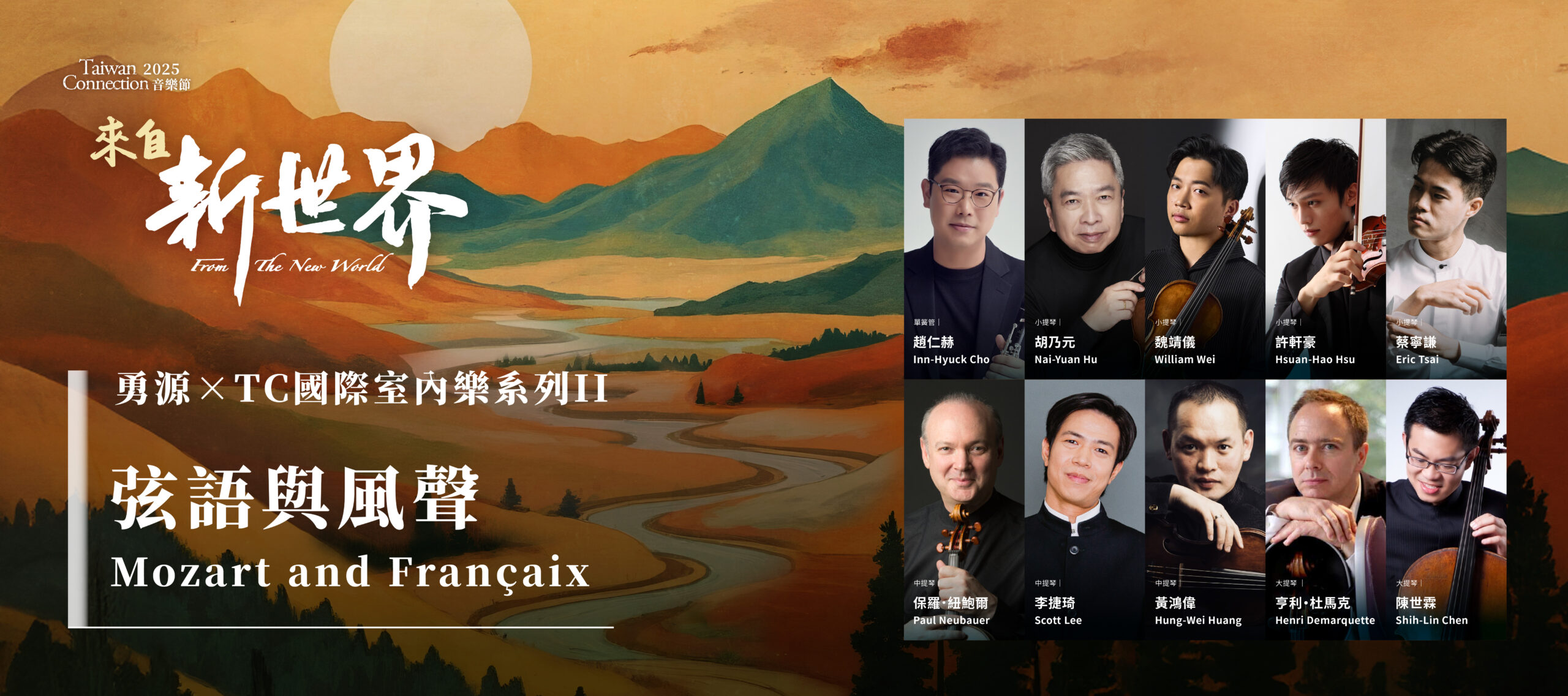
From Mozart to Françaix ‒Classical Echoes in the 20th Century
Over two decades of dedicated work, the Taiwan Connection Music Festival has carved its own distinctive artistic path. The repertoire performed over the years has already defined the Festival’s character: Mozart as a point of departure, a focus on 19th-century classics, and a substantial presence of 20th-century works. Alongside familiar masters, the Festival delights in introducing audiences to lesser-known voices—part of its endur- ing charm.
This concert brings together works by four composers, intention- ally stepping away from the 19th century. Pairing Mozart’s String Quintet in C major, K. 515 with three 20th-century works: Frank Bridge’s Lament for two violas, two viola duets by York Bowen, and Jean Françaix’s Clarinet Quintet. The concert title, Mozart and Françaix, clearly identifies these two composers as the pillars of the program.
Who Was Françaix? Jean Françaix has often been described as the Mozart of the 20th century—though he lived longer, and perhaps more fortunate. Born in 1912 in Le Mans, France, into a musical family, his father was a composer, pianist, musicologist, and director of the local conservatory, while his mother was a voice teacher. Showing precocious talent, Françaix began composing at age six and published his first work at ten. His promise quickly drew the attention of Nadia Boulanger, under whom he would study, and also earned him the praise of Maurice Ravel.
Françaix’s brilliance emerged against the dark backdrop of World War I and its aftermath. He rose to prominence during the cultural resurgence of the 1930s—a decade that marked his first major creative peak. In truth, Françaix remained prolific throughout his life. Though his output slowed during World War II, he resumed work after the war and continued composing into the 1990s, with a career that spanned over eighty years.
Françaix came of age during the height of neoclassicism, a movement that sought to return to order, clarity, and traditional forms in response to the chaos and dissonance of atonality. His compositional voice was shaped by this trend. The Clarinet Quintet, scored for string quartet and clarinet, reflects a thoroughly classical conception. Its four movements follow a structure reminiscent of 18th-century Baroque sonatas: slow–fast–slow–fast, with the first and third movements both marked by lyrical pacing.
Neoclassicism sought a “return to order” in response to modern- ism, embraced the elegance and balance of Baroque music while updating it with contemporary sensibilities. Françaix’s music is neither avant-garde nor merely nostalgic. Instead, his Clarinet Quintet sparkles with refined wit and humor, brought to life through agile interplay among the instruments. The clarinet alternates between lyrical lines and playful leaps across registers, showcasing the instrument’s full expressive range—from its rich, resonant low notes, through its warm, pliant middle register, to its brilliant and clear upper voice.
Paired with Mozart’s String Quintet in C major, Françaix’s work finds a natural complement. Both composers share an almost magical ability to conjure dazzling musical textures and ideas, seemingly plucked from thin air or from their sleeves like magicians. And yet their sleights of hand are utterly distinct. In Mozart’s hands, the five string parts take on operatic personali- ties; with lyrics and voices, the music could easily become a lively ensemble scene on stage.
This quintet, composed shortly after the premiere of The Marriage of Figaro, carries a strong operatic flavor. The opera, based on a controversial play by Beaumarchais, had been banned in France and was only approved in Vienna after substantial revisions by Mozart’s trusted librettist, Lorenzo Da Ponte. At the time, plans were already underway for Don Giovanni, also with a libretto by Da Ponte—whose dramatic flair likely lingered in Mozart’s imagination as he composed the quintet.
The cello’s opening gesture in the first movement recalls Figaro’s baritone energy, spirited and sly, or perhaps Leporello from Don Giovanni, breezily delivering his famous Catalogue Aria. These roguish, sharp-witted characters, irreverent, ambiguous, yet charming, undoubtedly appealed to Mozart’s taste. The quintet flows with confidence and clarity, full of invention and never a dull moment.
With these two masterful quintets forming the foundation of the program, the concert is further enriched by two viola duo works by British composers York Bowen and Frank Bridge, written before and after World War I. Bowen, one of Britain’s foremost early 20th-century pianists, was sometimes referred to as “the English Rachmaninoff”—an imperfect label, perhaps, but one that conveys the lyricism and expressive depth of his music. Bridge, who would go on to teach Benjamin Britten, offers in his Lament for two violas a work of deep introspection and inward searching. Together, these pieces bring a note of balance and contemplation to the concert’s colors.
Program
Musicians



Schedule
| 9/05 Fri. | 19:30 | Taichung | Taichung National Theater Playhouse |
| 9/11 Thu. | 19:30 | Taipei | NTCH Recital Hall |